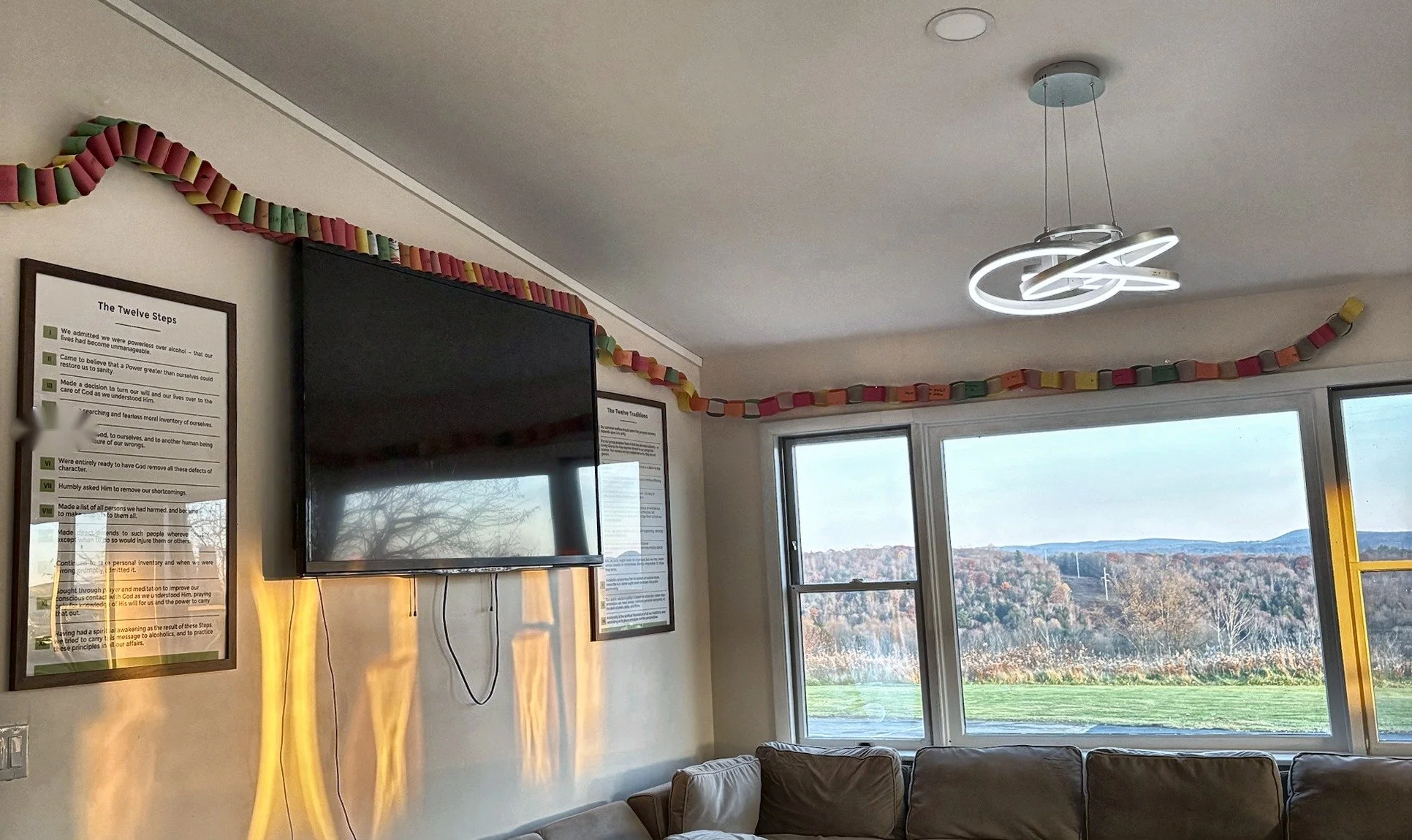
A colorful paper chain is growing in the Summit, our common room at Woodhaven. If it grows as much as I hope, it will eventually stretch down the hallways, past the boys' bedrooms, and into the dining room.
Every loop holds something someone is grateful for. Some are simple. Some are funny. Some have made me stop and think.
One resident wrote about the personal growth that came from getting through a difficult time. Another is grateful for the fellowship at Woodhaven. Someone appreciated a friend who makes him laugh when things are hard. Others wrote about family, sobriety, music, and the people who have helped them along the way.
I love reading them.
Just outside our front door, our November banner reads, "Gratitude Changes Our View." We have been exploring that idea in morning group, talking about the big things we are thankful for as well as the ordinary ones we tend to overlook.
Last year, we created a gratitude garland with families during Family Day. This year, I wanted to take the idea a little further. We started with the boys, writing on colorful strips of construction paper and connecting them into loops. Most days, we stop for a few minutes and add to the chain. Staff and visitors have been contributing their own, and our families will join in during Family Group and Family Day. We will continue adding to it throughout November.
What I like most is that each loop begins as one person's thought. We all have different experiences, different challenges, and different things that matter to us. Yet as the strips connect, those individual thoughts become something we are building together. In a recovery community, where so much of the work is personal but none of it is done alone, that feels right.
Something happened last night that made me think about our banner a little differently.
I was on the phone with a dear friend who is also one of our family group facilitators. We had not spoken in several days, and I spent much of our conversation catching her up on some difficult things happening in my life. The past couple of weeks have been hard, and there was a lot to talk about.
I was grateful to have someone listen, but honestly, I did not feel particularly better after saying everything out loud. My worries and sadness were still there.
Eventually, our conversation turned to the Family Group we were preparing for and the gratitude activities at Woodhaven. It was getting late, and I needed to get off the phone to make dinner.
Instead, I found myself saying, "Wait, let's not hang up yet. Let's do our gratitudes."
So we did.
We each shared three things we were grateful for. We limited ourselves to three because of the time.
And when we finished, I realized I actually felt better. Not a little better. Noticeably better.
Nothing about my circumstances had changed. I had no solutions to the things I was worried about or any immediate resolution to the hurt I was carrying. But for those few minutes, I had stopped focusing on what was difficult and given my attention to things in my life that I genuinely appreciated.
I felt lighter.
I wish I could tell you I woke up this morning feeling the same way. I did not. The fears and sadness were still there.
But I keep thinking about how much those few minutes helped.
We talk about gratitude so often in recovery that I wonder whether sometimes we forget what the practice itself can do. It is one thing to understand that gratitude matters. It is another to stop what we are doing, recognize something good in our lives, and say it out loud.
I do not believe gratitude asks us to be happy with everything happening around us. We can appreciate the people we love and still worry about them. We can recognize how much good there is in our lives while carrying sadness, disappointment, or uncertainty.
Both can be true.
Gratitude does not have to change our circumstances to change how we feel. Sometimes that difference may last only a little while.
And sometimes a little while is exactly what we need.
This morning, I found myself thinking again about our garland at Woodhaven. Each strip holds a little piece of someone's life. A person they love. Something that makes them laugh. An opportunity they appreciate. Perhaps even something good that came from a difficult experience.
We do not always know the story behind the words. We just know that someone stopped for a moment, thought about something they were grateful for, and added it to the chain.
I hope our garland keeps growing throughout November, with more people finding reasons to add another loop, even on days when gratitude takes a little more effort.
I know my worries are not going to disappear because I think about something good. But I know how I felt after that conversation. So today, when my thoughts drift back toward the things I cannot change, I am going to try to pause and name something I am grateful for.
It may not change the day ahead.
But perhaps it will make parts of it a little easier.